The honest version, first
If you are weighing up a move out of clinical work, the money is probably the thing keeping you awake. So here is the honest version before anything else. Leaving clinical work does not automatically mean a pay cut. It also does not guarantee you keep your salary. The truth sits in between, and it depends almost entirely on which route you take and how much experience you carry into it.
Most articles on this dodge the question with “it depends” and a shrug. This one does not, because it is built on two things a general career blog does not have. The first is the real Agenda for Change pay scale for 2025/26 in England, so every pound quoted here is an actual salary, not a rounded guess. The second is our own database of NHS job packs, which tells us which non-clinical roles genuinely sit at which band, and how confident we can be about it.
A note on honesty before we start. We will tell you plainly where our evidence is strong and where it is thin. When a role-to-band mapping is built on many job packs across many trusts, we will say so. When it rests on only a handful, we will say that too, and you should weigh it accordingly. A number you can trust is worth more than a number that sounds confident.
How Agenda for Change bands map onto non-clinical roles
Almost every non-clinical and digital role inside the NHS is paid on the same Agenda for Change (AfC) scale you already know from clinical work. That is the good news for anyone worried about stepping into an alien pay system. The bands run from Band 2 near the bottom to Band 9 at the top, and each band has a few pay steps you move up with time in role.
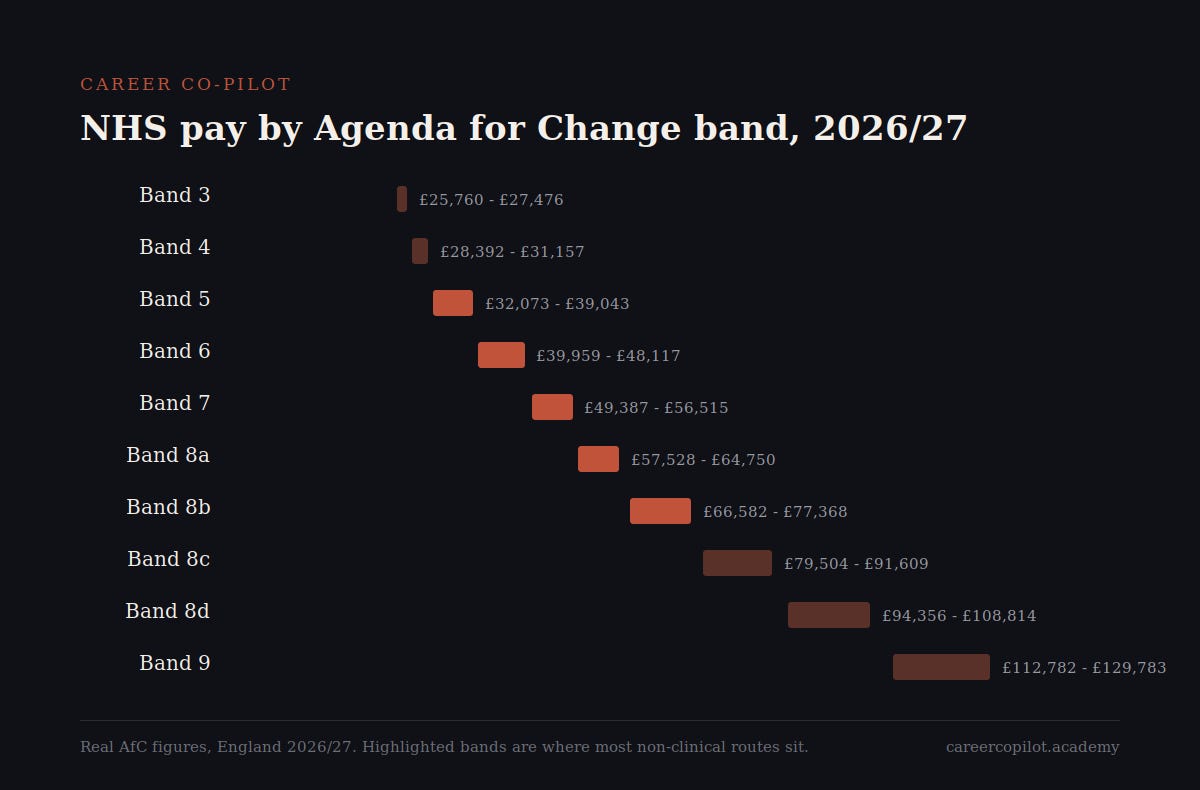
Here is the real AfC scale for the bands most non-clinical routes use, for 2026/27 in England. Every figure below comes straight from our pay data.
Which role families sit where
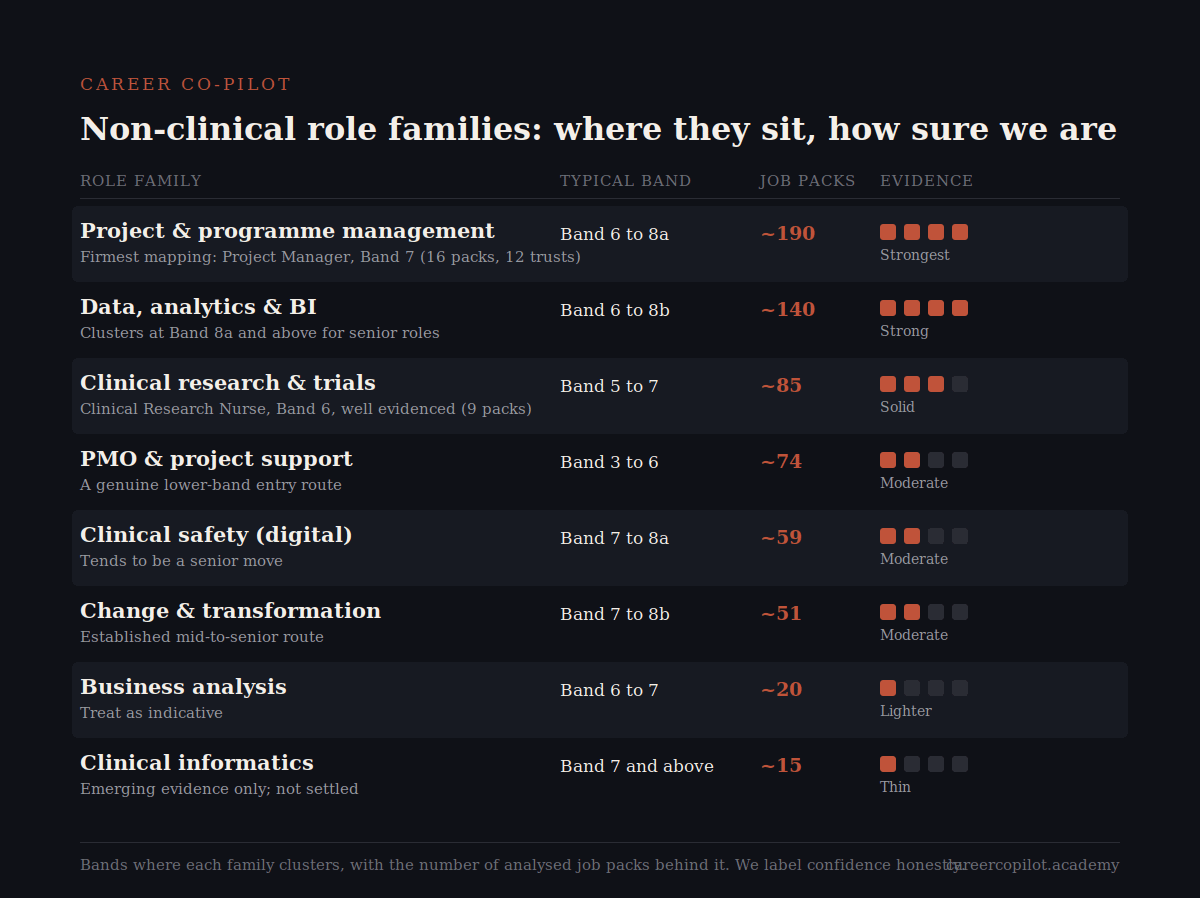
Using our job-pack database, here is where the main non-clinical role families tend to land. The right-hand column is the important one. It tells you how much evidence sits behind each mapping, counted in job packs we have analysed. Treat a family built on many packs as solid, and one built on few as a signpost rather than a promise.
Pay by band, route by route
Now the part you came for. For each of the best-evidenced routes, here is the band you would usually enter at, the band the role typically sits at, where it can progress to, and the real salary attached to each. Every pound is from the 2026/27 AfC scale above.
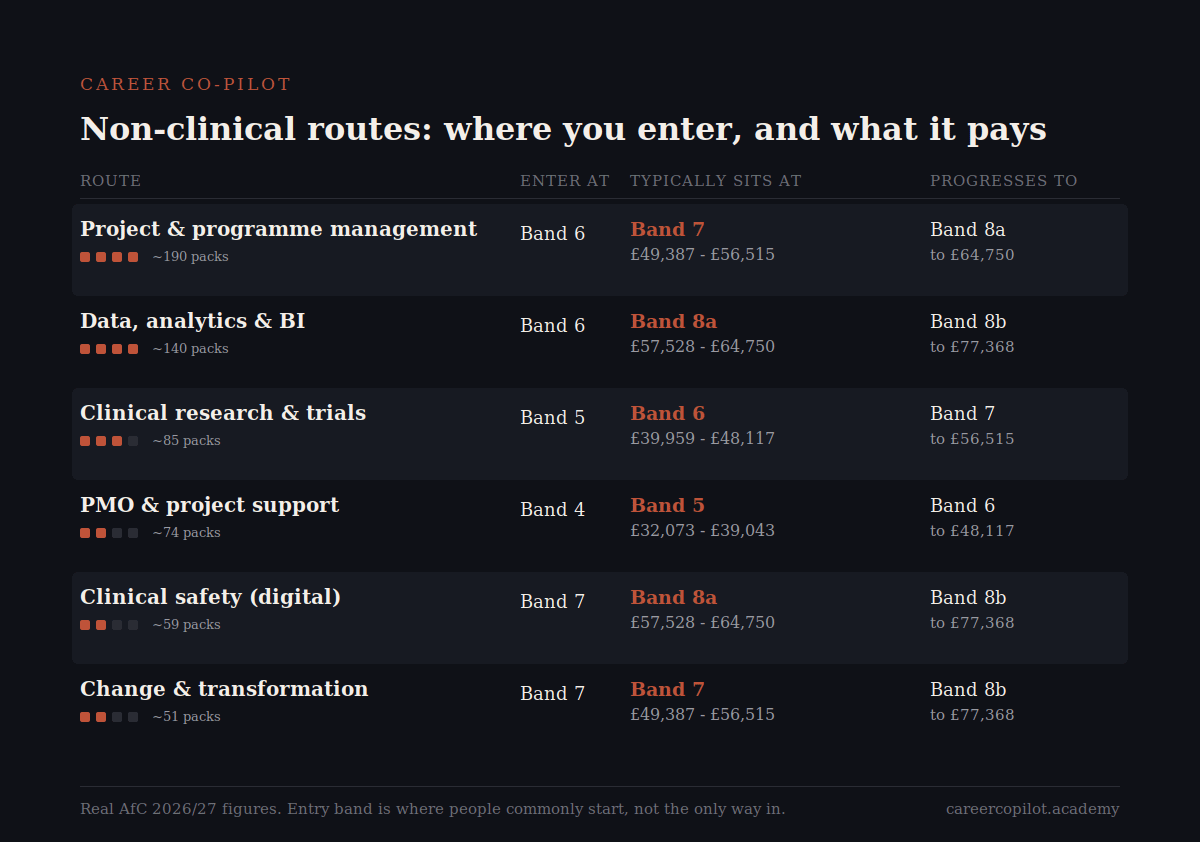
A few honest reads on that table. Project and programme management is the route we can speak about most confidently, because it has by far the most evidence behind it, and because Project Manager at Band 7 is the one mapping in our whole database strong enough to call settled. If you want the surest-footed answer on money, this is it. A Band 7 project role pays £49,387 rising to £56,515, and a step up to Band 8a takes that to between £57,528 and £64,750.
Data and analytics is where the ceiling is highest inside the NHS. Senior roles cluster at Band 8a and reach into Band 8b, which tops out at £77,368. One caveat worth stating: our firmest single data-role mapping, Data Science Manager at Band 8b, comes from one organisation, so treat the exact title with a little caution even though the band pattern across the family is strong.
If you are looking for a way in that does not demand seniority on day one, PMO and project support is the honest answer. It starts lower, often around Band 4 at £28,392 to £31,157, but it is a real door into the project world, and Band 5 and Band 6 follow with experience.
We have left clinical informatics out of the core table on purpose. It is one of the routes people ask about most, but our evidence for it is still thin, around 15 job packs, and it would be dishonest to put a firm band and salary against it here. What we can say is that the roles we have seen tend to sit at Band 7 and above. Treat that as a direction of travel, not a quote.
How your current pay compares
The real question underneath all of this is simple. Will I be worse off? The answer depends on where you are standing now.
If you are a nurse, midwife or allied health professional, you are already paid on this exact AfC scale, so the comparison is clean. A Band 5 nurse earning between £32,073 and £39,043 who moves into a Band 6 project or research role at £39,959 to £48,117 is not taking a cut at all. They are stepping up. A Band 6 clinician moving into a Band 7 project role goes from a top of £48,117 to a range of £49,387 to £56,515. Again, no cut, and often a rise. This is the part that surprises people most: for many nurses and AHPs, the well-evidenced non-clinical routes match or beat their current band rather than dropping below it.
If you are a doctor, the comparison is different and we will not pretend otherwise. Doctors are paid on separate medical pay scales, not on Agenda for Change, and those figures are not in the data behind this article, so we are not going to quote them at you. What we will say honestly is this. A move from a medical training salary or a consultant salary into an AfC band can mean a real pay change, up or down depending on your grade, and you should place your current pay point against the band figures above using the official medical pay circular for your grade. If that comparison shows a gap, the section below on lifestyle, and the portfolio routes we cover elsewhere, are where the honest trade-off gets weighed.
To compare your own position, take your current pay point and read it against the band table above. For AfC staff that is a direct comparison. For doctors, use your current medical pay circular as the starting figure. Every non-clinical figure here is real; the only number we are asking you to bring is your own.
Industry versus the NHS
A fair question at this point is whether you would earn more doing similar work outside the NHS altogether. We can offer an indicative comparison, and we want to be clear about what it is and is not.
The figures below are the standard salary rates set for each occupation under the UK Skilled Worker visa system, matched to comparable role types. They are a useful reference point because they are official and consistent. They are not market medians, and they are not what any given employer will actually offer. Read them as a floor-level indicator of how these roles are valued outside the NHS, not as a salary you should expect.
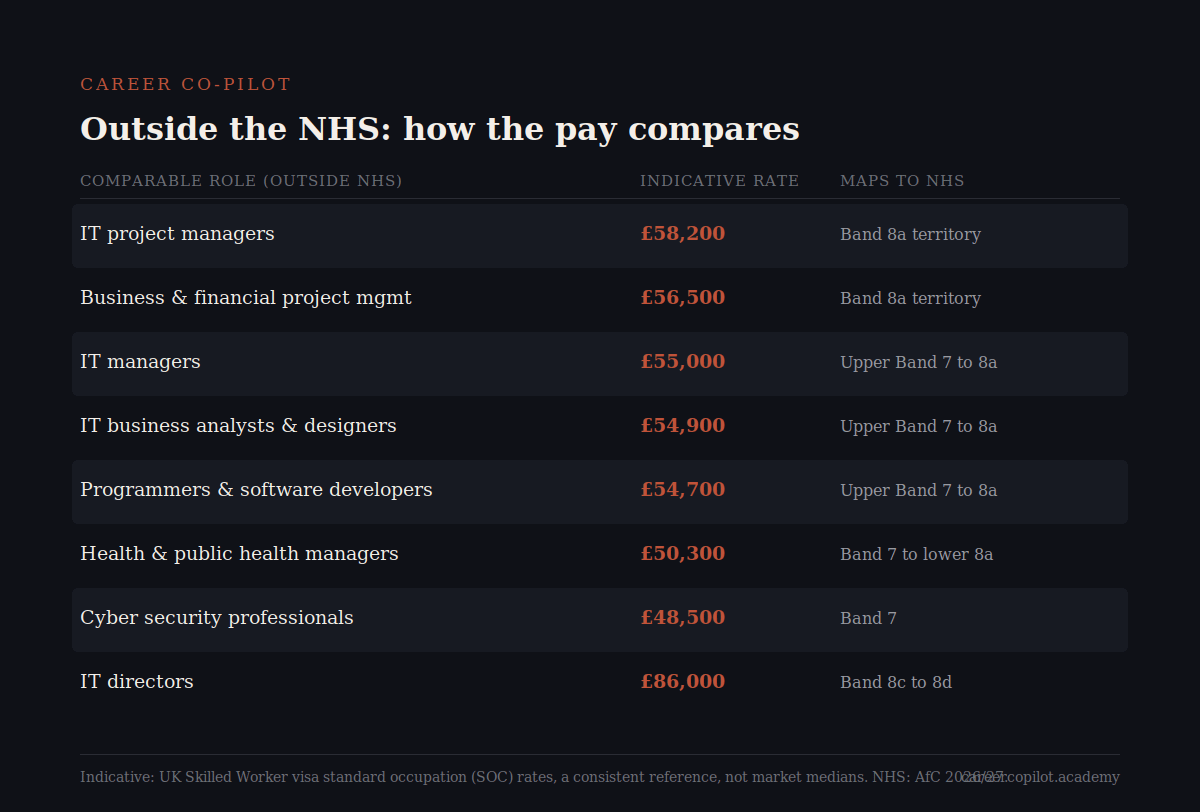
The honest headline from that comparison is that the gap is smaller than the common wisdom suggests. For project, analyst and even software roles, the indicative outside-NHS rates land in much the same place as an NHS Band 7 or Band 8a. The NHS is not the outlier people assume it to be at these levels. Where industry pulls clearly ahead is at the top, in director-level technology roles. Where the NHS holds its own, and adds a pension and terms that are hard to match, is across the broad middle where most of these moves actually happen.
The pension question
This is the part that quietly matters most over a career, and it is the part we are not going to improvise. Whether you keep your NHS pension terms depends on whether your new role stays inside the NHS pension scheme or moves you onto something else, and the detail is too consequential to guess at. Until that section is completed from official guidance, treat the pension as a live and important factor in any move that takes you outside the NHS, and one worth getting proper advice on.
Money versus lifestyle, honestly
Pay is only one column in the decision, and pretending it is the whole thing would not serve you. So here is a fair way to weigh it up, without either doom or false promise.
• Start from a real number, not a fear. Place your current pay against the band table above. For most nurses and AHPs, the well-evidenced routes hold or improve on your band, so the pay cut you may be dreading often is not there.
• Weigh the whole package. A lateral move on pay that gives you predictable hours, no night shifts and control over your week is not a lateral move on quality of life. Count that honestly on the other side of the ledger.
• Be honest about a genuine dip. Some routes, and some moves out of medicine in particular, can mean a real short-term drop. That is a legitimate reason to plan the timing, not necessarily a reason to abandon the move. A lower band you can live in beats a higher band that is emptying you out.
• Look at the ceiling, not just the entry. Several of these routes reach Band 8a and 8b, between £57,528 and £77,368. The first step is rarely the destination.
• Do not let the pension be an afterthought. It is the quietest and largest part of the trade-off over time. Get the facts before you decide.
The point of grounding all of this in real figures is not to talk you into leaving or to talk you out of it. It is so that whatever you decide, you decide it on the numbers rather than on a 2am fear about the numbers. For a lot of people, seeing the real bands is the moment the move stops feeling reckless and starts feeling like a plan.
Cheers,
Dr. Ron
Join over 6000+ subscribers at Behind The Scenes in Health with Dr.Ron’s substack where we share insightful information around healthcare and health tech.
Help us grow on YouTube channel by subscribing, commenting and sharing as we post new videos every Friday by 7pm (WAT). Give us a follow on TikTok
If there are topics you would love to read about or guests you would like to see and hear on the podcast, please email me at ronald@mrimedic.com or podcast@mrimedic.com
Here is our linktree. Feel free to explore our pages.
Stay tuned for more inspiring stories and insights into the world of alternative careers. Subscribe to our blog for updates and join us on this journey where passion meets purpose.
The numbers in this piece come from Career Co-Pilot, the platform I built to track non-clinical NHS career intelligence. If you want the full breakdown of all six sub-tracks under Clinical Safety, including bands, employers, salaries and transition pathways, the role guide is at careercopilot.academy.
Sources
Agenda for Change pay data 2026/27 (England). Role-to-band data from Career Co-Pilot job-pack extractions, with confidence levels shown. Indicative outside-NHS figures from UK Skilled Worker visa standard occupation (SOC) rates, used as a reference only, not market medians. Pension section to be completed from official NHS Pensions / NHSBSA guidance.