Two fears turn up whenever a clinician asks this question. The first is that outside the ward none of it counts. The second is that you would need to learn to code to be taken seriously. Both are wrong, and it is worth saying so plainly before anything else.
Most digital and non-clinical roles are not looking for a software engineer. They are looking for someone who understands care well enough to see when a system is about to hurt a patient, and who can carry other people through change. You already are that person. The work is learning to name it in language a non-clinical hiring manager recognises.
What the job packs actually ask for
We analysed the essential and desirable requirements across our database of NHS non-clinical and digital job packs. The competencies that come up most often are not technical. They are the things clinical work builds in you every day. Here are the ones that appear most across the roles we have seen, counted by how many job packs list them.
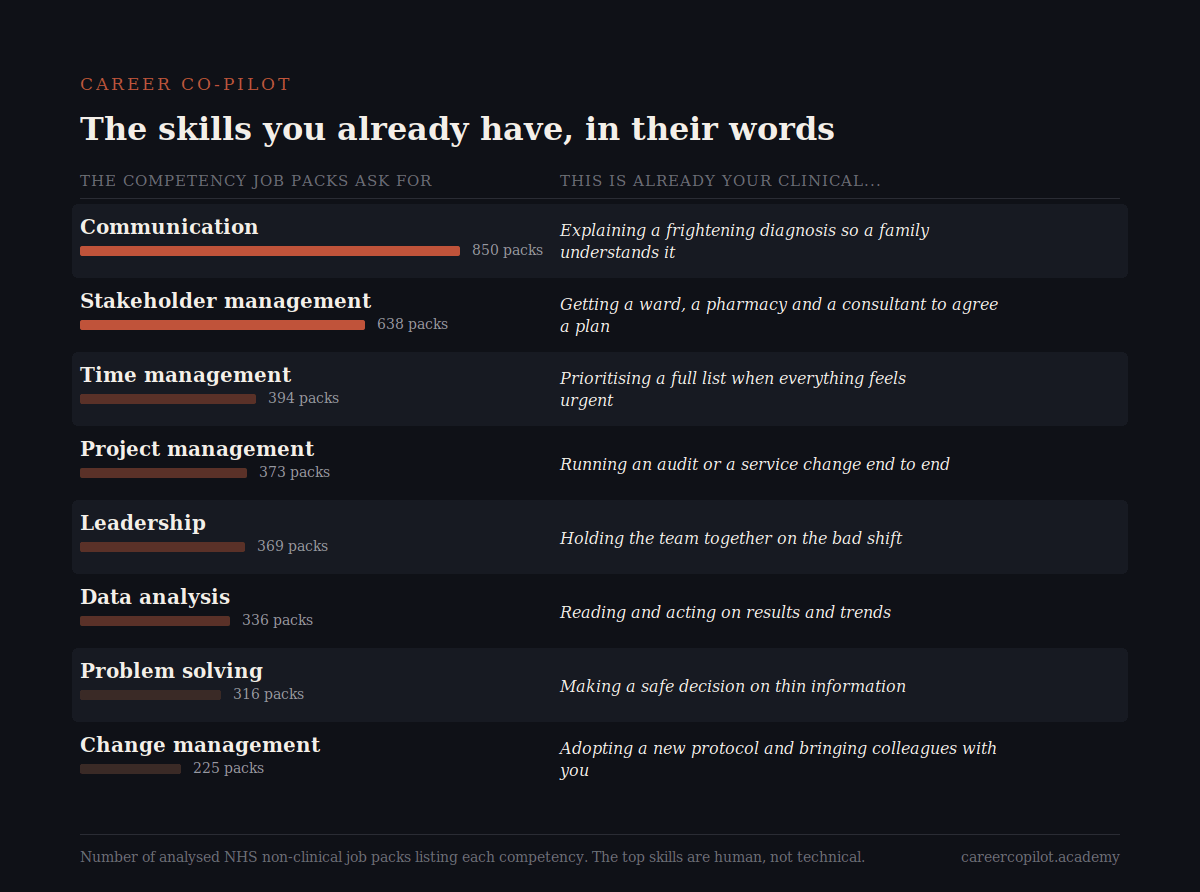
Read that table again, because it is the whole point. The single most requested thing in these roles is communication, and it appears in 850 of the job packs we analysed. Stakeholder management appears in 638. These are not skills you need to go and acquire. They are skills you use before your first coffee. The job is translation, not transformation.
Where coding actually matters
It would be dishonest to say technical skills never come up, so here is the honest version. In senior data and analytics roles, specific tools do become genuinely essential. In the Band 8b analytics roles we looked at, SQL was listed as essential in a little under half of them, and Python in around a third. If you are aiming squarely at senior data science, that is a real gap to plan for. But that is one corner of one domain. Across the broad middle of non-clinical and digital work, the technical bar is far lower than the fear suggests, and clinical judgement is the scarce thing.
How to close a genuine gap cheaply
Being honest about the gaps is part of earning your own confidence. Where a real skill is missing, most can be picked up without a degree. A secondment onto a digital project, a short course in a specific tool, or volunteering for the analytics side of an audit will do more for a application than another qualification. The point is to get one piece of concrete, nameable experience you can put on the page.
A worked example
Take one ordinary line from a clinical role and turn it into something a non-clinical reader values. Before: “Managed acute admissions on a busy medical take.” After: “Prioritised competing urgent demands under time pressure, coordinated across multiple teams, and communicated decisions clearly to colleagues and patients.” Same work. The second version speaks in the exact competency language the job packs ask for, and it is all true.
If turning your whole clinical CV into that language feels daunting, that is precisely what our CV reframe tool is built to help with. But the raw material is already yours.
Cheers,
Dr. Ron
Join over 6000+ subscribers at Behind The Scenes in Health with Dr.Ron’s substack where we share insightful information around healthcare and health tech.
Help us grow on YouTube channel by subscribing, commenting and sharing as we post new videos every Friday by 7pm (WAT). Give us a follow on TikTok
If there are topics you would love to read about or guests you would like to see and hear on the podcast, please email me at ronald@mrimedic.com or podcast@mrimedic.com
Here is our linktree. Feel free to explore our pages.
Stay tuned for more inspiring stories and insights into the world of alternative careers. Subscribe to our blog for updates and join us on this journey where passion meets purpose.
The numbers in this piece come from Career Co-Pilot, the platform I built to track non-clinical NHS career intelligence. If you want the full breakdown of all six sub-tracks under Clinical Safety, including bands, employers, salaries and transition pathways, the role guide is at careercopilot.academy.