A senior stakeholder needs a dashboard by the end of the week, and the data they want lives across three different systems that do not talk to each other. You write the queries, build the pipeline, and turn a messy set of sources into a Power BI report someone can actually make decisions from. Then you sit with them and explain what it means.
This is a Tier 2 role for us, built on four job packs so far, so read it as a signpost. It sits within data, analytics and business intelligence, which our domain data describes as the largest non-clinical digital field, running from Band 3 to Band 8d.
What the role actually does
• Build, maintain and administer Power BI dashboards and reports to meet internal and external deadlines
• Write and optimise queries in T-SQL and PostgreSQL to extract, transform and deliver accurate datasets
• Develop and maintain automated data pipelines
• Support scalable and reliable reporting infrastructure using cloud data solutions
• Gather and translate stakeholder requirements into structured reporting outputs
• Support target setting and identify opportunities for improvement
A day in the life
You will own and maintain Power BI dashboards, responding to stakeholder reporting deadlines while designing automated reports drawing from sources such as System One, EMIS, Access HR and Excel. You will gather requirements from senior stakeholders for new reporting requests, write complex T-SQL and PostgreSQL queries to build accurate datasets, and contribute performance analysis to support strategic and operational initiatives. You may also deliver workshops and training sessions to internal users to embed data literacy across the organisation.
What it pays
Our packs for this role did not record a single consistent Agenda for Change band. In our domain data, data and analytics roles run from Band 3 all the way to Band 8d, with a clean ladder from data quality upward. An analyst role of this kind typically sits in the lower to middle of that range. For exact figures by band on the 2026/27 scale, see our pay guide.
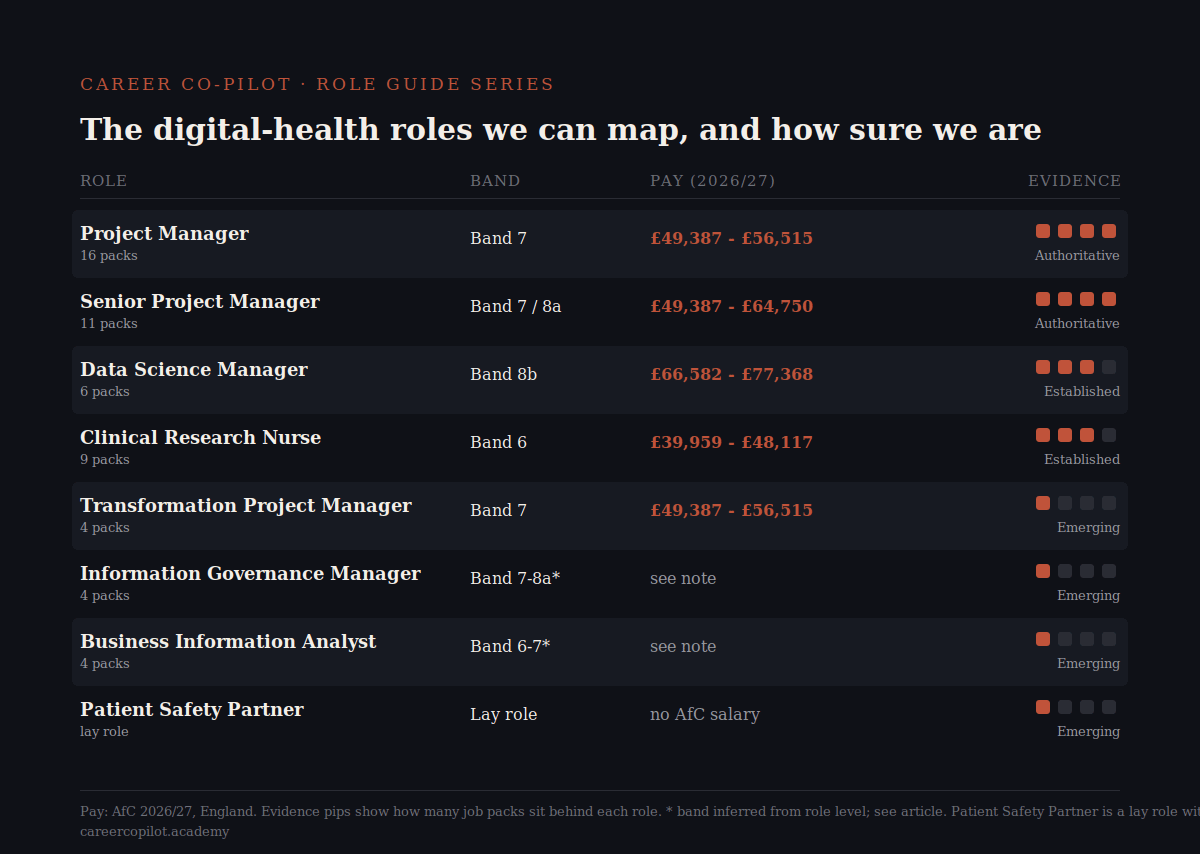
Band range from the domains sheet (data, analytics and BI); we have not asserted a specific band because our packs for this role did not record one. Pay detail: Brief 2 (Agenda for Change 2026/27).
What it screens for
Be clear-eyed about this one. It screens for real technical skills: Power BI, T-SQL and PostgreSQL, and automated data pipelines. This is not a soft-entry route where clinical experience alone will carry you.
What clinical and operational experience does give you is the other half the packs ask for: understanding NHS systems like System One and EMIS, scoping what a stakeholder actually needs, and explaining the numbers in plain language. The technical skills are learnable, but they are genuinely required.
What is hard about it
Balancing multiple concurrent reporting deadlines across a range of stakeholders while maintaining data accuracy and pipeline reliability is a recurring pressure. Integrating data from diverse and sometimes complex NHS clinical and HR systems, including System One, EMIS and Access HR, requires both technical depth and careful requirement scoping. Ensuring non-technical senior stakeholders receive clear, actionable insights demands strong communication alongside the analytical work.
Who moves into it, and where it leads
Progression beyond this level would typically require demonstrated leadership of a BI team or function, ownership of enterprise-wide data strategy, and experience delivering large-scale data architecture or transformation. Exposure to advanced cloud engineering and data governance frameworks would signal readiness for a senior or principal role.
You are likely to work within a Business Intelligence or Data Analytics function, engaging regularly with senior stakeholders across operational and strategic teams. The role carries ownership of reporting infrastructure, suggesting a degree of autonomy with oversight from a Head of Analytics, BI Manager or equivalent.
How to get in
With four packs, treat these as directional.
• The realistic route in is via a data quality or junior analyst role, where you build SQL and Power BI on the job.
• A portfolio of real dashboards and queries matters more than a certificate for this role.
• Your knowledge of NHS clinical systems is a genuine advantage over an outside analyst, so lead with it.
• Our guide on whether you need coding or a data qualification sets out honestly where the technical bar applies.
Cheers,
Dr. Ron
Join over 6000+ subscribers at Behind The Scenes in Health with Dr.Ron’s substack where we share insightful information around healthcare and health tech.
Help us grow on YouTube channel by subscribing, commenting and sharing as we post new videos every Friday by 7pm (WAT). Give us a follow on TikTok
If there are topics you would love to read about or guests you would like to see and hear on the podcast, please email me at ronald@mrimedic.com or podcast@mrimedic.com
Here is our linktree. Feel free to explore our pages.
Stay tuned for more inspiring stories and insights into the world of alternative careers. Subscribe to our blog for updates and join us on this journey where passion meets purpose.
The figures here come from Career Co-Pilot, my platform for non-clinical NHS career intelligence, built on real NHS job-pack data. Full breakdown at careercopilot.academy.