Picture a clinic where the letter to the GP is already written before the patient has left the room. The clinician didn’t type it or dictate it afterwards. A piece of software listened to the consultation, drafted the letter and the notes, and the clinician checked them and signed them off.
That is ambient voice technology, usually shortened to AVT and often called an AI scribe. In 2026 it stopped being an experiment.
What It Actually Is
An AI scribe listens to a conversation between a clinician and a patient, with the patient’s consent, and turns it into a structured draft: clinic notes, a letter, a summary. The clinician reviews, corrects and approves it.
It does not diagnose, decide or replace the clinician. It takes the typing away and leaves the thinking. The clinician remains responsible for every word that goes into the record.
The Main Types of AI Scribe
Not every AI scribe works the same way. Broadly, there are four kinds:
Standalone apps. The clinician opens an app on a phone, tablet or browser, records the consultation, then copies the draft into the record. They are quick to start with, and common in pilots.
Built into the clinical system. The scribe sits inside the software clinicians already use, such as the GP record or the hospital electronic patient record, so the draft lands where it belongs. There is less copying and pasting, but buying it is a bigger decision.
Dictation companies adding ambient listening. Firms that have done medical dictation and transcription for years are adding ambient features to tools many clinicians already know.
Telephone and video scribes. These are built for remote consultations, which matters in general practice, where a large share of contacts are now by phone.
Who Provides Them
In January 2026, NHS England published a registry of suppliers that say their AI scribes meet its standards. It started with 19 suppliers, and more have been added since:
33n (CLEARnotes), Accurx, Anathem, Aprobrium (Lexacom), Beam Up, Corti, Dictate IT, eConsult, HealthOrbit AI, Heidi Health, Lyrebird Health, Microsoft Dragon, Optum (EMIS), Pungo (Joy), Scribetech (Augnito), Tandem, Tortus, T-Pro and X-On Health.
Some are start-ups. Others are names your service may already use for GP systems, online consultations, phone systems or dictation. Being on the list is not an NHS endorsement. Each organisation still has to check that a tool is safe before using it. That checking, confirmation, deployment and training is where many of the new jobs come from.
Where It Is Already Happening
Across my news feed, I have tracked more than 110 stories about AI scribes since July 2025. Read in order, they show a technology moving from pilot to policy in about a year:
October 2025: a £150 million national framework opens to help NHS organisations buy AVT.
January 2026: NHS England lists 19 suppliers meeting the criteria for its ambient voice registry.
April 2026: NHS England publishes guidance on the safe use of ambient scribes.
July 2026: the MHRA clarifies when these tools count as medical devices.
August 2026: an investigation opens into how AVT is being used in hospitals.
September 2026: Wales opens a £10 million framework of its own.
October 2026: Barts Health gives more than 2,000 clinicians access. Half of the clinicians in its pilot said it saved them at least five minutes per appointment.
It is not only the UK. Australia’s medicines regulator found that 8 of the 12 AI scribes it reviewed are likely to be medical devices. New Zealand is extending its national rollout into emergency mental health.
What Changes for Clinicians
For most clinicians especially those who work in the outpatients and emergency departments, the first change is time. Five minutes an appointment, across a full clinic, adds up to hours a week given back to patients or to the end of the day.
The second change matters more for careers: responsibility shifts from writing to checking. Someone has to decide whether the tool is safe to use, what happens when it gets something wrong, how patients are told, and who signs off the risk. That work does not disappear. It becomes someone’s job, and this job has to be taken seriously.
The Jobs It Creates
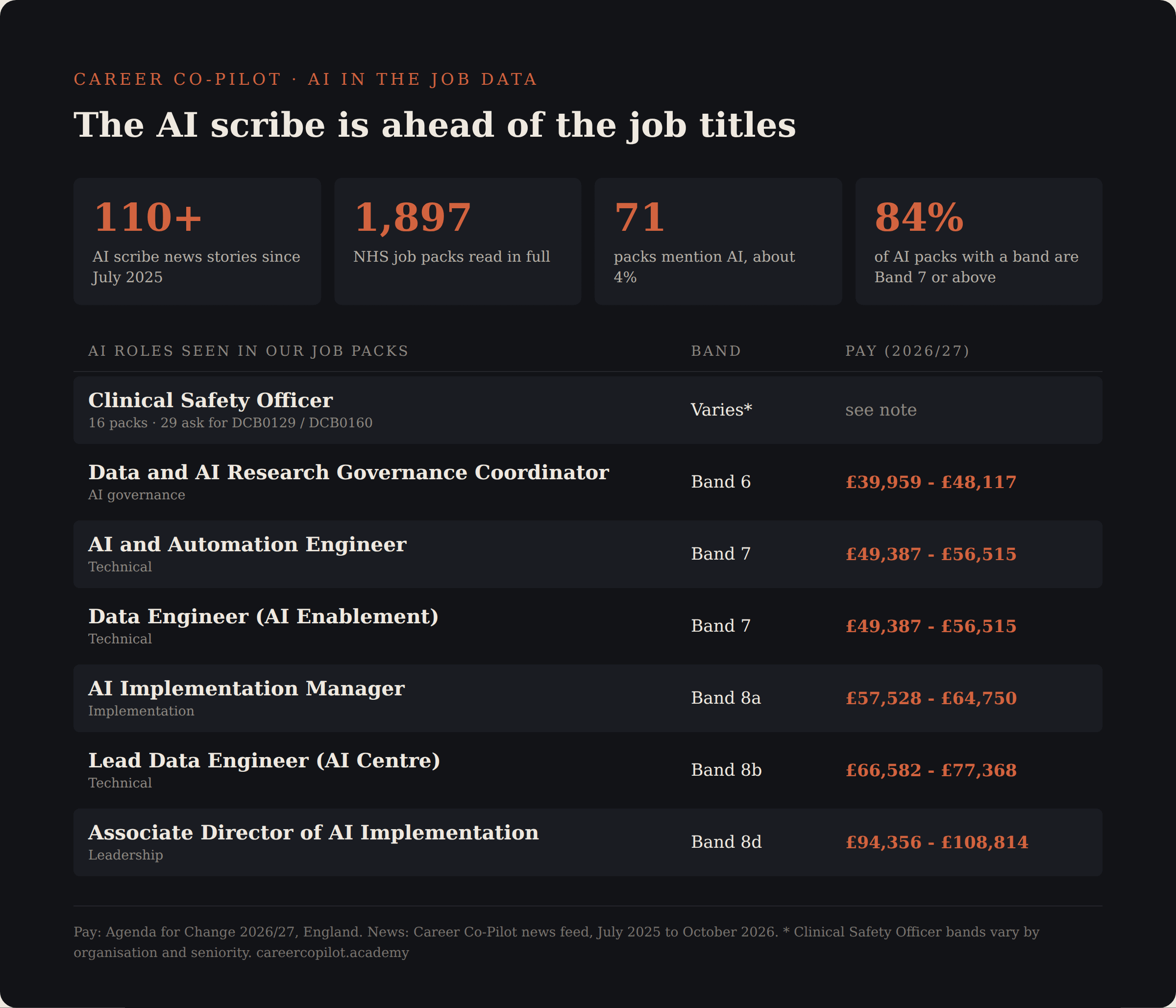
This is where the numbers get interesting. I looked at the 1,897 job adverts that we have read in full at Career Co-Pilot:
71 packs mention AI (about 4%). The titles are new: AI Implementation Manager, Associate Director of AI Implementation, Data Engineer (AI Enablement), AI and Automation Engineer, Data and AI Research Governance Coordinator.
AI work starts senior. Of the AI packs that state a band, 84% are Band 7 and above.
Clinical safety is the established route in. 16 packs are Clinical Safety Officer roles, and 29 ask for knowledge of DCB0129 and DCB0160, the NHS clinical safety standards that every AI scribe rollout must meet. This is important especially for clincians who are looking to balance clinical work and digital technology due to the fact that clinical safety officers require a professional registration to be eligible for this role. It is a hard gate!
In the news, we have seen more than 110 news headlines and several national frameworks, but almost no job adverts that name AI scribes. The technology is ahead of the job titles. Trusts are rolling it out now and staffing it from existing teams.
When a dedicated rollout is staffed, these are the roles it usually needs:
Project and programme managers to plan the rollout, manage suppliers and report on progress until transition into business as usual.
Adoption and change specialists to work with each team, deal with concerns and make sure the tool is actually used and benefits realised , not just switched on.
Digital trainers to show clinicians how to use the tool, basic troubleshooting, record consent and check the draft properly.
Clinical champions who use it first, give feedback and help colleagues get better at using it.
Clinical safety officers to write the safety case, log what goes wrong and ensure that no patient harm happens due to the use of the tool.
Information governance and data protection leads to cover consent, recording and where the data goes.
Several of these are good entry points for people coming from outside clinical work. A trainer, a project officer or an adoption lead does not need a clinical registration but does need to understand how a clinic runs.
That is the window. The people who get those posts will be the ones who were already in the room when the first rollout happened which makes a case of actively being on the lookout when these projects are being rolled out in your organisation so that you can get involved.
How to Position Yourself
Learn the clinical safety standards. Read DCB0129 and DCB0160. If your organisation has a Clinical Safety Officer, ask what a safety case for a new digital tool involves. This is the single most transferable skill in this space.
Volunteer for the pilot. If your service or department is trialling an AI scribe, be the person who gives structured feedback, not the one who tolerates it. Pilots need champions, and champions get noticed.
Offer to train others. If you pick up a new tool quickly, say so. Digital trainer and adoption roles often go to the person colleagues already ask for help.
Write down what you learn. Time saved, errors caught, how patients reacted. That record becomes your evidence for an implementation, project or digital role later.
Talk to your digital team. Ask who is leading AI scribe or clinical information work in your organisation. Most of these teams welcome people who want to help.
Keep your clinical credibility. If you are a clinician, the most valuable thing you bring to this work is being able to say, “I have run that clinic myself.”
Where to Learn More
There are a couple of events we have seen that AI scribes and AI will be discussed. It will be great to attend at least one to get a feel of the conversation and figure out how to align yourself. The list includes but is not exhaustive:
AI in Healthcare: A Practical Guide to Medical Device Development, a webinar series from Health Data Research UK, from 12 November.
The Caldicott Guardian and AI, 8 December, on data protection and governance.
AI in Healthcare Conference 2027, Manchester, 23 February.
Digital Health Rewired 2027, Birmingham, 16 to 17 March, the main UK digital health conference.
All of these, and more, are on the Career Co-Pilot events page.
AI scribes will not take clinicians’ jobs. They will change what the job involves and create a set of new ones around it. The question is whether you are watching that happen or helping to shape it.
I prefer to be part of the group helping to shape it. I don’t know about you.
Cheers,
Dr Ron