After a series of deliberations and advocacy from several groups, in March 2026, a new law changed who gets first call on UK medical training posts. The first full recruitment round under it has now finished, and the numbers are in.
If you are an international medical graduate (IMG), or you mentor one, this is the clearest picture, yet of what has changed and where the open routes are now.
What Changed
The Medical Training (Prioritisation) Act (MTA) became law on 5 March 2026. It puts certain applicants ahead of everyone else for foundation year (FY) and specialty training posts, whatever their overall ranking.
The priority group includes graduates of UK and Irish medical schools, graduates from Iceland, Norway, Liechtenstein and Switzerland, and doctors who have completed UK foundation or earlier specialty training. In 2026 it also included some doctors based on their residence status. The government has confirmed that the 2026 categories will be used again for 2027.
I am not going to say who falls into which group. That depends on individual circumstances, and the official guidance from NHS England and your deanery is the place to check.
What the First Round Shows
The headline numbers from NHS England and the Nuffield Trust:
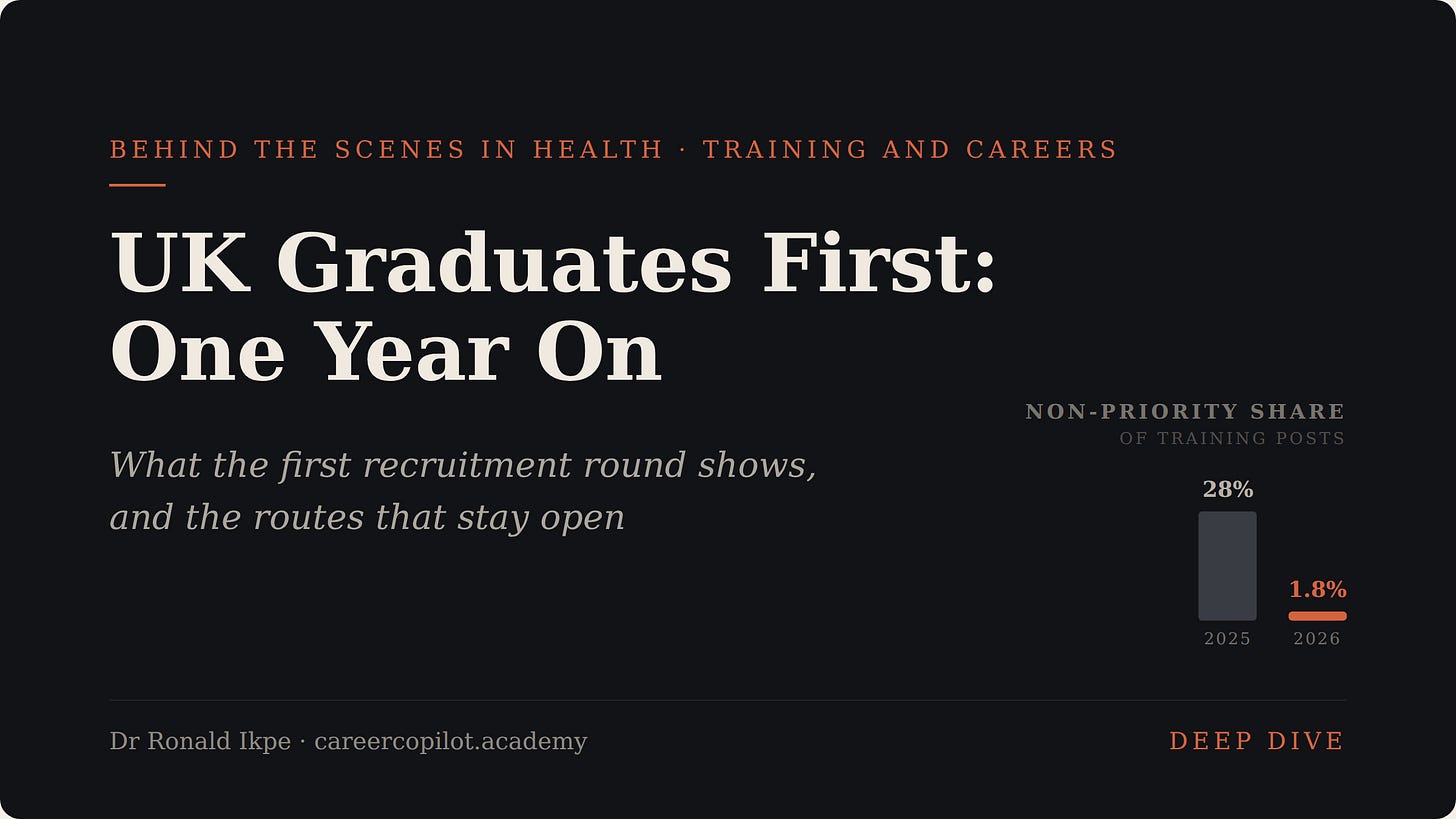
Doctors outside the priority group took 1.8% of specialty training posts in 2026, down from 28% in 2025.
Accepted offers to that group fell from 2,168 to 163.
98% of posts went to priority candidates, up from 72%.
Every GP training place went to the priority group, up from 62%.
Only 5 of 16 specialties accepted any doctors from outside the priority group.
And yet 51% of applications still came from doctors outside the priority group. Thousands of doctors applied for posts that, under the new rules, were almost all going to someone else.
What Changes Next Year
Two things to know for 2027:
Prioritisation now starts at shortlisting. In 2026 the law arrived after applications had closed, so it only applied at the offer stage. From 2027 it also applies at interview selection.
“Significant NHS experience” is not defined yet. The law allows for it, but in September the government said there isn’t yet enough evidence to set a threshold. For 2027, the existing categories stay.
Meanwhile, the Nuffield Trust warns that the specialties that relied most on international doctors, including general practice, psychiatry and obstetrics, are the most at risk of shortfalls. The government has agreed to fund up to 4,500 extra training places over three years. Whether that changes the picture for doctors outside the priority group is not yet clear. We can only wait and see what happens.
The Bigger Picture
According to the GMC, 42% of doctors on the UK register qualified abroad. Growth in international joiners has slowed sharply, and the number of non-UK doctors leaving the UK rose by 26%.
Our own news feed shows the same shift. Stories on prioritisation and international doctors went from about one a month in late 2025 to four already this October.
The Doors That Stay Open
This is the part that gets lost in the headlines. Training is one route into a medical career in the UK. It is not the only one.
1. Non-training doctor posts. Specialty doctor, specialist grade and clinical fellow posts are not training posts, so the prioritisation law does not cover them. They are a well-trodden route to UK experience, and some doctors build whole careers in them.
2. The portfolio pathway. Doctors can join the specialist or GP register by showing their training and experience are equivalent, without a formal training programme. It is slower and needs careful evidence, but it does not depend on getting a training number. Five of the job packs we have read mention it.
3. Roles where your medical degree counts beyond clinical practice. This is where our data comes in. In the job packs we have read at Career Co-Pilot, 17 roles outside doctor posts ask for a medical degree or GMC registration, and 42 more are open to any registered clinician, doctors included. The 17 include:
Clinical Safety Officer, Band 7 to 8b
Lead Business Intelligence Analyst (cancer), Band 7
Clinical Informatician, Band 8a
Chief Clinical Information Officer, Band 8d
Chief Medical Information Officer, on medical or local pay
Training Programme Director, in medical education
Deputy Regional Director, Band 9
Chief Medical Officer and Deputy Chief Medical Officer
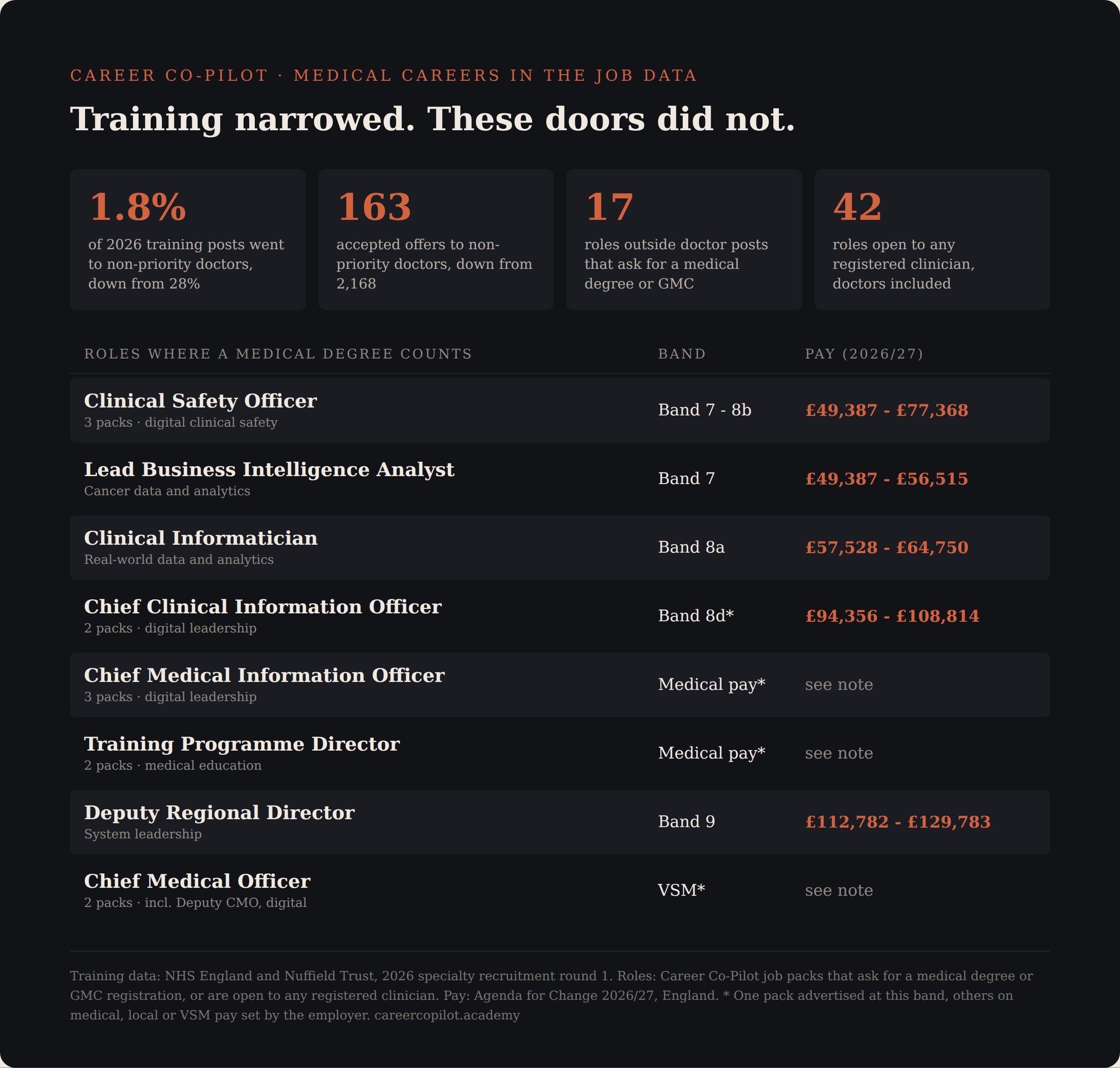
Source: NHS England and Nuffield Trust, 2026 specialty recruitment round 1. Roles: Career Co-Pilot job pack analysis. Pay: Agenda for Change 2026/27, England.
Digital health, clinical safety, informatics, data, medical education and leadership value clinical knowledge, and are not bound by training rules. Some of these roles are senior and expect experience. Others, such as clinical safety, informatics and analytics, are realistic entry points for a doctor willing to build the skills.
What to Do Now
Check where you stand, from the official source. Read NHS England’s guidance on prioritisation before you plan your next application. Don’t rely on social media summaries.
Don’t put all your hopes on one route. If you are applying for training in 2027, run a parallel plan: a non-training post, the portfolio pathway, or a role that uses your degree differently.
Treat a non-training post as a base, not a waiting room. Collect the evidence the portfolio pathway asks for from day one: audits, teaching, logbooks, supervisor reports.
Look sideways as well as up. If clinical safety, data or digital health interests you, start learning now. A short course and a project in your current post can open those roles.
Talk to people who have done it. Many doctors now in senior UK posts did not come through the standard training route. Ask how they did it.
The law has done what it was designed to do: UK graduates now get first call on training. For everyone else, the job is to stop waiting for that door and look at the others. There are more of them than most people think.
Cheers,
Dr Ron